Epsilones |
| ► Fragmentos |
|
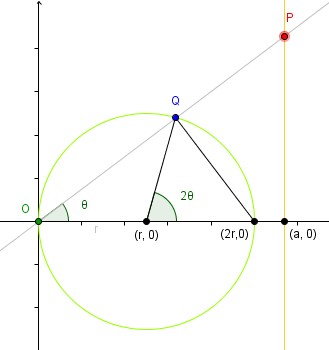
En la sección de curvas se define la cisoide de la siguiente manera: "dadas dos curvas en polares \(\rho_1=f_1(\theta)\) y \(\rho_2=f_2(\theta)\), su cisoide es la curva \(\rho=f_1(\theta)-f_2(\theta)\)". Vamos a obtener aquí la cisoide de una circunferencia de centro en (r,0) que contiene al origen de coordenadas y una recta vertical de ecuación \(x = a\), caso representado en la figura.
|
| Comentarios |
Epsilones.
|
Con esto se termina la página: